
Piper, John: St Sauvant
£6,500.00
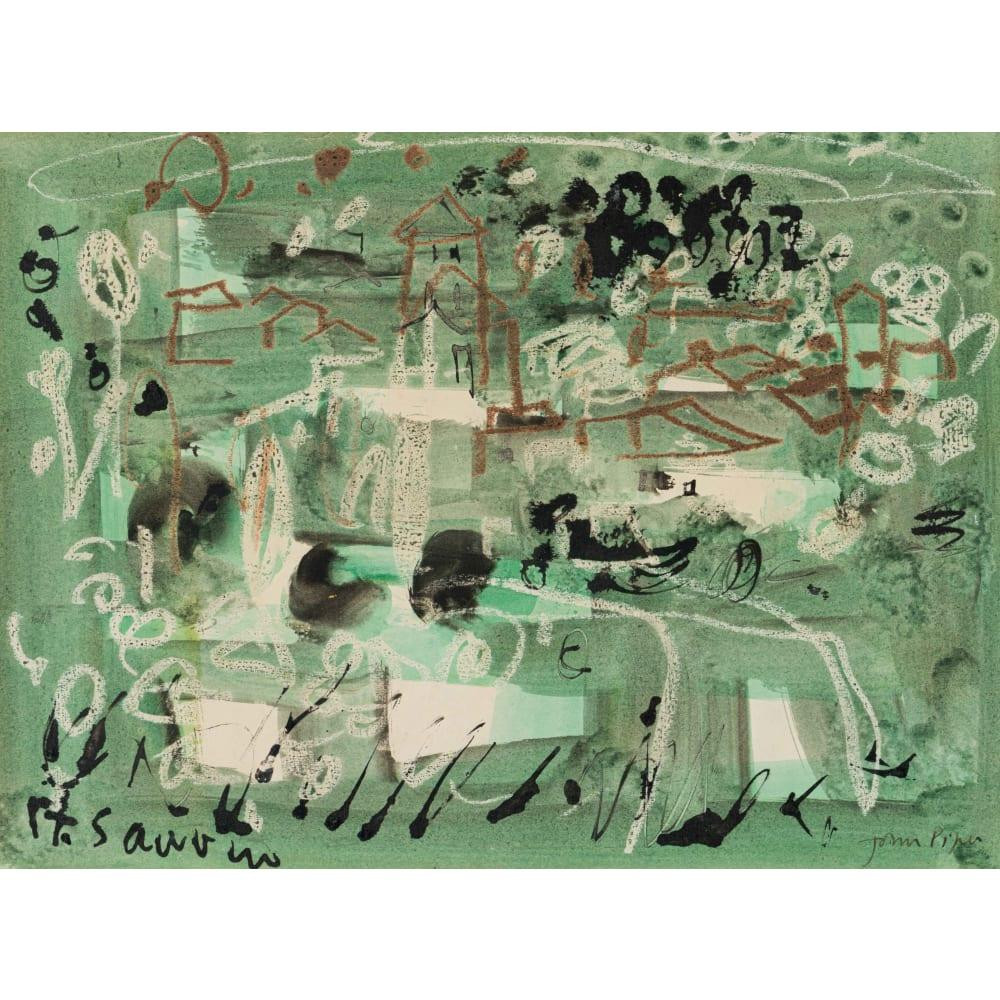
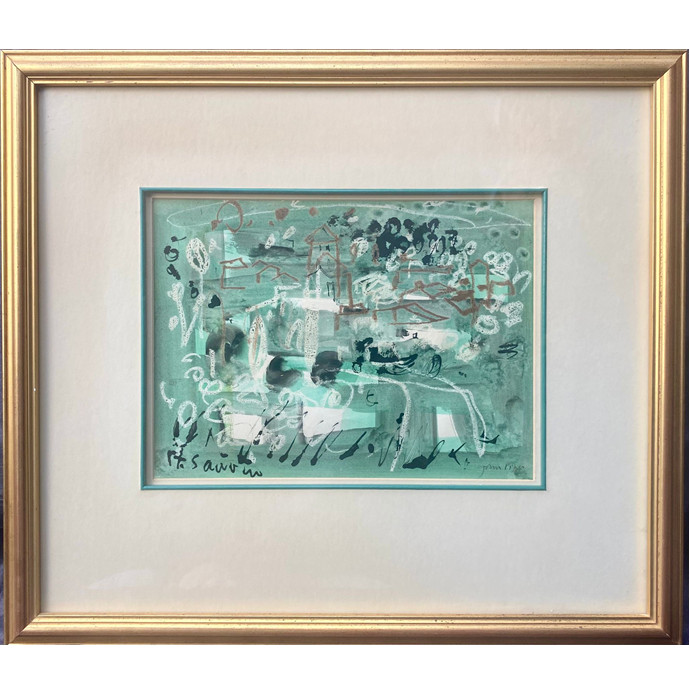
A lovely, loose and abstract country landscape typical of works undertaken by Piper on holidays in France in the 1960s. A signed pastel, ink and watercolour on paper, the painting is in excellent condition with strong colours and is presented in its original gilt frame. The location is inscribed on the painting and to the rear although incorrectly recorded as St Sauvin rather than St Sauvant.
We are extremely grateful to Hugh Fowler-Wright, Piper collector and author for the following interpretation:
‘John Piper was primarily a topographical painter and this seemingly light touch, assemblage of mark making is in reality a deft, complex image. The apparent swift construction of finite elements is borne of decades of observing how man and nature have shaped landscapes. Piper alludes to a foreground then uses a road to take the eye into the assembly of buildings which are layered onto a tree dotted middle ground. The rapid, yet fluent, gestural marks adroitly place the references to the outlines of houses and a church as if they are floating within and on the terrain. This is a key message that Piper wishes to convey – how he saw, felt and responded to the scene on that day, at that time and from that location. He was striving to convey how the man-made buildings reside in this particular landscape location when he was there. Recording his sense of place.
“A good picture says something which cannot be said in any other way; indeed unless it does so it is not a good picture.”’
Saint-Sauvant is a village on the banks of the Charente between Cognac and Saintes in the Nouvelle-Aquitaine region of western France.
More images can be provided on request.
Artist: John Piper (British, 1903-1992), signed
Title and date: St Sauvant, 1960s
Size: 21.5 by 29.0 cms; 46.0 by 52.5 cms including the frame.
Description
Artist description:
Born in Epsom in 1903, John (Egerton Christmas) Piper, widely known as ‘JP’, studied at Richmond School of Art and the Royal College of Art from 1927-8 and in the mid-1930s. After a visit to Paris, he turned to abstraction, he became a member of the London Group in 1933 and a founder member of the ‘Seven and Five’ group in January 1934. During this period, he became friends with Oliver Simon of the Curwen Press and his interest in lithography and printmaking grew to become one of the main media in which he worked.
By the end of the 1930s, he had become disillusioned with abstraction and returned to a more naturalistic and representational approach. He concentrated on landscapes and architectural views in a distinctive style characterised as continuing the English Romantic or Neo-Romantic tradition.
During the Second World War, Piper was appointed as an official war artist recording the effects of the blitz on Britain’s buildings, especially churches. After the war, he became a Trustee of the Tate and National Galleries and in 1959 he became a member of the Royal Fine Art Commission.
A quintessentially English and 20th century artist, John Piper was endlessly innovative and extraordinarily prolific. He was dedicated to excellence and quality in all he did and there is hardly a medium in which he did not excel, including ceramics, fabric design, mosaics, murals, photography, stage sets and costume design, stained glass and even designing fireworks displays, he was also editor of the Shell Guide series for some 40 years.
He is best known for his extensive studies of British architecture, especially churches, and for landscapes in oil, watercolour and print. His work is often characterised by a bold use of colour, dynamic composition and an ability to capture the character of a place with a strong sense of atmosphere.
His work is avidly collected and is held in many museums and galleries but he was no establishment man, a position which may partly explain his ridiculously low profile in the art world. He loathed the Royal Academy and refused a knighthood in 1972 though he accepted a Companion of Honour for ‘distinction in arts’, something of an understatement. He died in 1992 just short of his 90th birthday.